
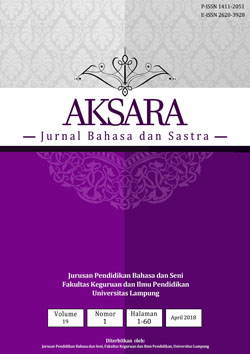

Artikel (40)
The research investigates the cohesion and coherence of descriptive texts written by tenth graders at senior high school in Subang, Indonesia. Using a qualitative case study design with text analysis, data were obtained from three texts that represent low, middle, and high achievers. The analysis em...
AKSARA: Jurnal Bahasa dan Sastra ; Vol. 26 No. 2 (2025): Aksara: Jurnal Bahasa dan Sastra; 599 - 611 | 2025
Penelitian ini mengkaji tipologi morfologis kata kerja intransitif dalam bahasa Jawa, berfokus pada data yang bersumber dari artikel Majalah Djaka Lodang. Melalui analisis konten interaktif (Miles & Huberman, 2014), studi ini berhasil mengidentifikasi delapan pola morfologis dominan: tanpa afiks...
AKSARA: Jurnal Bahasa dan Sastra ; Vol. 26 No. 2 (2025): Aksara: Jurnal Bahasa dan Sastra; 584 - 598 | 2025
Deep Learning (DL) has become the current issue in educational field and claimed good attentions from educators and policy makers all around the globe. Deep Learning in Indonesia was introduced as educational policy at the end of 2024. As a new educational policy, the research conducted is still lim...
AKSARA: Jurnal Bahasa dan Sastra ; Vol. 26 No. 2 (2025): Aksara: Jurnal Bahasa dan Sastra; 570 - 583 | 2025
Penelitian ini bertujuan untuk mendeskripsikan jenis dan makna metafora dalam puisi “Uhibbuki” karya Nizar Qabbani. Penelitian ini merupakan penelitian deskriptif kualitatif dengan objek penelitian berupa puisi tersebut. Teknik pengumpulan data menggunakan teknik membaca dan mencatat. Sumber uta...
AKSARA: Jurnal Bahasa dan Sastra ; Vol. 26 No. 2 (2025): Aksara: Jurnal Bahasa dan Sastra; 546 - 554 | 2025
This study aims to analyze how patriarchal culture is represented in TikTok content using Roland Barthes’ semiotic model, which consists of three levels of meaning: denotation, connotation, and myth. The background of this research lies in the persistence of patriarchal values in Indonesia, where ...
AKSARA: Jurnal Bahasa dan Sastra ; Vol. 26 No. 2 (2025): Aksara: Jurnal Bahasa dan Sastra; 555 - 569 | 2025
This study explores the phenomenon of Foreign Language Speaking Anxiety (FLSA) as experienced by students of the Faculty of Economics and Business, University of Lampung. Using a descriptive qualitative approach, the research aims to understand how psychological, emotional, and social factors contri...
AKSARA: Jurnal Bahasa dan Sastra ; Vol. 26 No. 2 (2025): Aksara: Jurnal Bahasa dan Sastra; 533 - 545 | 2025
his study aims to identify the pronunciation of interrogative sentences in Egyptian Arabic, focusing on suprasegmental features encompassing frequency, duration, and intensity among native and non-native Egyptian participants. The research employs an experimental design using an instrumental approac...
AKSARA: Jurnal Bahasa dan Sastra ; Vol. 26 No. 2 (2025): Aksara: Jurnal Bahasa dan Sastra; 513 - 532 | 2025
This study aims to analyze grammatical and lexical cohesion in Mata Najwa's podcast titled Ahok about Jokowi, Prabowo, and Jakarta Today. Using a qualitative descriptive method, this study identifies and describes various aspects of cohesion contained in the dialogue between Najwa Shihab and Ahok. T...
AKSARA: Jurnal Bahasa dan Sastra ; Vol. 26 No. 2 (2025): Aksara: Jurnal Bahasa dan Sastra; 500 - 512 | 2025
The discussion in this study is about the perlocution of hoax news of the Houthi conflict in Yemen using a pragmatic cyber review. the purpose of this study is to reveal the impact using a pragmatic cyber approach. The type of research that will be used in this research is descriptive qualitative. T...
AKSARA: Jurnal Bahasa dan Sastra ; Vol. 26 No. 2 (2025): Aksara: Jurnal Bahasa dan Sastra; 486 - 499 | 2025
This study aims to analyze the characteristics of literary reading assessments in the 2023 Revised Edition of the Indonesian Language Textbook for Grade X Senior High School, focusing on the various tests used and the levels of thinking involved, based on Barrett's Taxonomy. This study employed a qu...
AKSARA: Jurnal Bahasa dan Sastra ; Vol. 26 No. 2 (2025): Aksara: Jurnal Bahasa dan Sastra; 450 - 465 | 2025